Sample — Chapter 1
Having trouble viewing it? Open the sample chapter PDF.
Deferred maintenance does not save money. It borrows money - from your future self, at terrible rates, with the due date chosen by the failure.
A $150 weekday drain cleaning becomes a $450 emergency — plus the turnover when a good tenant leaves.
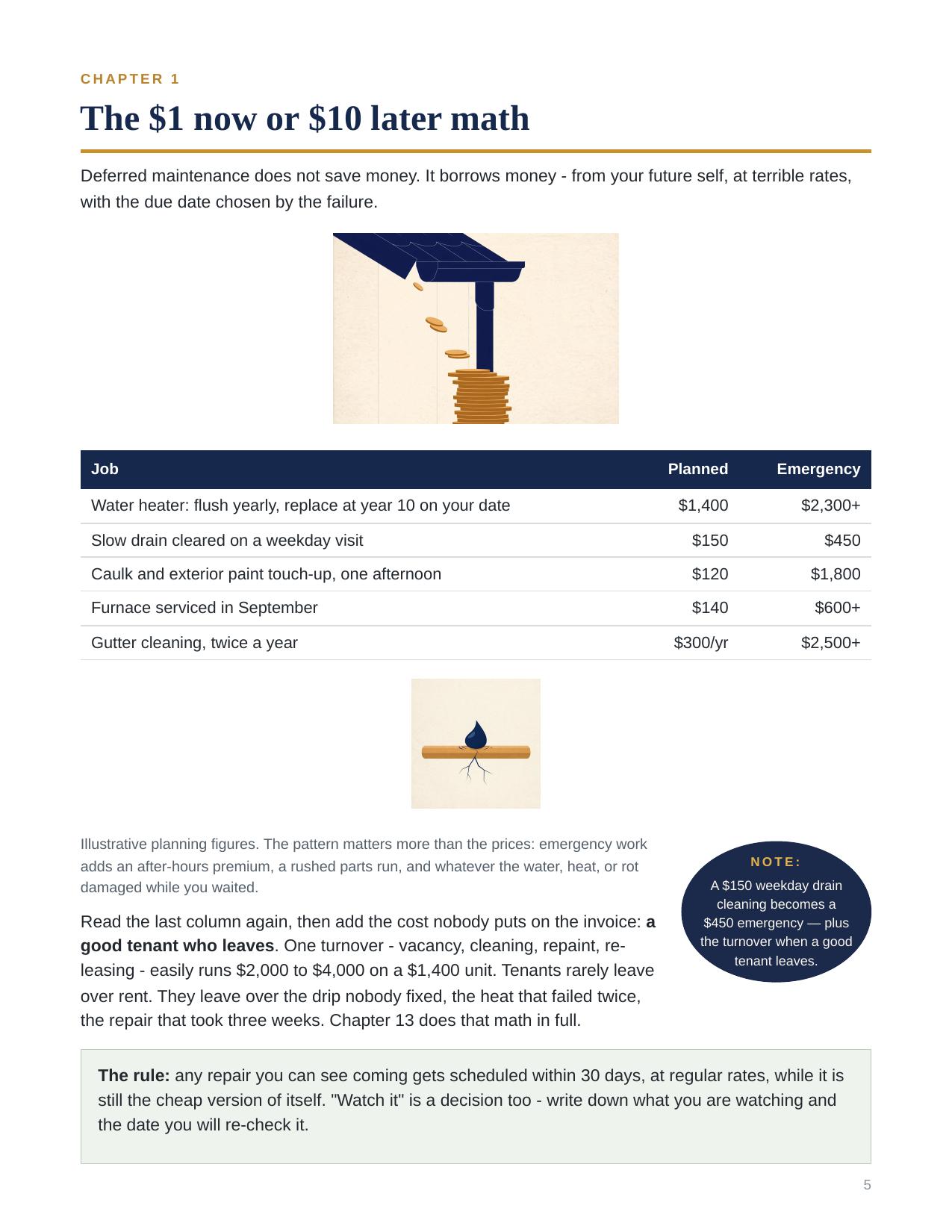
Illustrative planning figures. The pattern matters more than the prices: emergency work adds an after-hours premium, a rushed parts run, and whatever the water, heat, or rot damaged while you waited.
Read the last column again, then add the cost nobody puts on the invoice: a good tenant who leaves . One turnover - vacancy, cleaning, repaint, re-leasing - easily runs $2,000 to $4,000 on a $1,400 unit. Tenants rarely leave over rent. They leave over the drip nobody fixed, the heat that failed twice, the repair that took three weeks. Chapter 13 does that math in full.
The rule: any repair you can see coming gets scheduled within 30 days, at regular rates, while it is still the cheap version of itself. "Watch it" is a decision too - write down what you are watching and the date you will re-check it.
You cannot plan a roof you have never dated. Before the first walkthrough, build a one-page inventory for each property. It takes an hour, once, and it powers every budget in this book.
One hour, one page: every system's age and expected life powers every budget in this book.
Where the ages hide. The water heater's data plate shows the year. Appliance serial numbers decode online in two minutes. The furnace has a service sticker history. Old closing paperwork and permits often date the roof. When you truly cannot date something, write "unknown - assume second half of life" and budget accordingly.
Keep the inventory where a vendor can hear it over the phone: "40-gallon gas water heater, 2017, basement, 32-inch door." That one sentence saves a diagnostic trip and gets you a real price on the first call.
Maintenance feels random only because it is unfunded. Split it into two buckets and fund both monthly, per door.
Fund $125-$175 per door, per month . Use $150 as the default. Newer, renovated units sit at the low end; older houses with original systems sit at the high end. This bucket pays for the plumber, the appliance repair, the locksmith, the patch and paint.
Fund $150 per door monthly for repairs plus capital — unfunded maintenance is a surprise with a due date.
Fund it from the sinking-fund math in Chapter 11. For a typical older house it lands near $150-$250 per door, per month ; a newer property may need $100-$150. Chapter 10's table and Chapter 11's worked example show exactly how to compute yours.
On a unit renting for $1,400, that is 18-27% of rent set aside before you call anything profit - which is why experienced landlords underwrite maintenance and capital at purchase, not after the first roof quote.
Mechanics that make it stick: separate savings account, automatic transfer on the 1st, and a hard rule - the account is spent only on the property, and a balance below two months of funding gets refilled before any distribution to yourself.
Schedule it for the first dry weekend after the last frost - about 90 minutes per property. Bring this page, a phone for photos, a flashlight, and a moisture meter if you own one. Give tenants proper notice, in writing, per your local law.
Ninety minutes on the first dry weekend after the last frost catches winter damage while it is still cheap.
Close-out rule: every item found becomes one of three things before you leave - fixed on the spot, scheduled with a date, or written on the watch list with a re-check date. Nothing lives in your memory.
Schedule it 4-6 weeks before your first hard freeze. Fall work is winter insurance: nearly every January emergency was visible in October.
Nearly every January emergency was visible in October — walk 4 to 6 weeks before the first hard freeze.
The frozen-pipe talk. Thirty seconds, every fall, in plain words: "If we get a hard freeze while you're away, keep the heat at 60, open the cabinet doors under the sinks, and call me before you call anyone else." It has saved more money than any tool in this book.