Sample — Chapter 1
Having trouble viewing it? Open the sample chapter PDF.
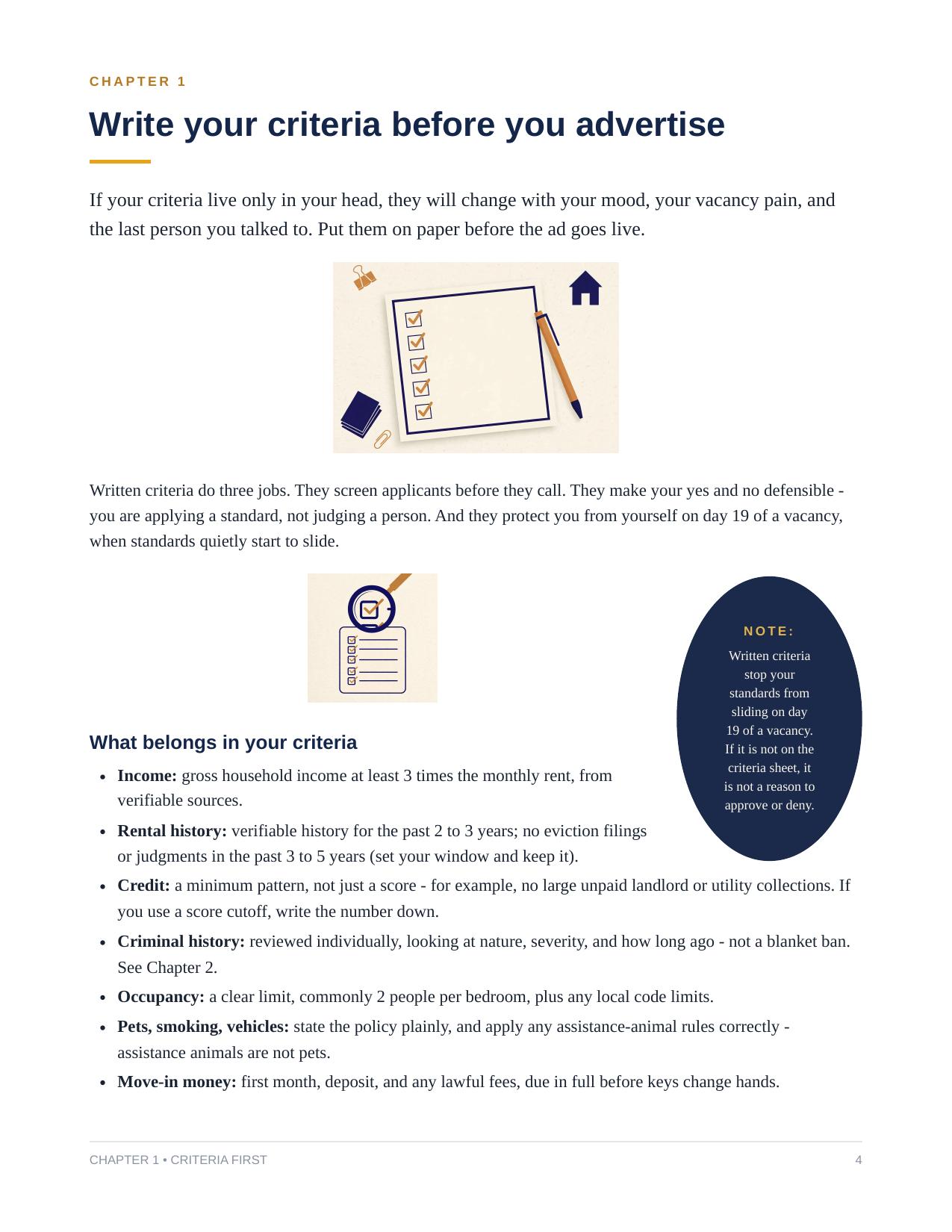
If your criteria live only in your head, they will change with your mood, your vacancy pain, and the last person you talked to. Put them on paper before the ad goes live.
Written criteria do three jobs. They screen applicants before they call. They make your yes and no defensible - you are applying a standard, not judging a person. And they protect you from yourself on day 19 of a vacancy, when standards quietly start to slide.
Written criteria stop your standards from sliding on day 19 of a vacancy. If it is not on the criteria sheet, it is not a reason to approve or deny.
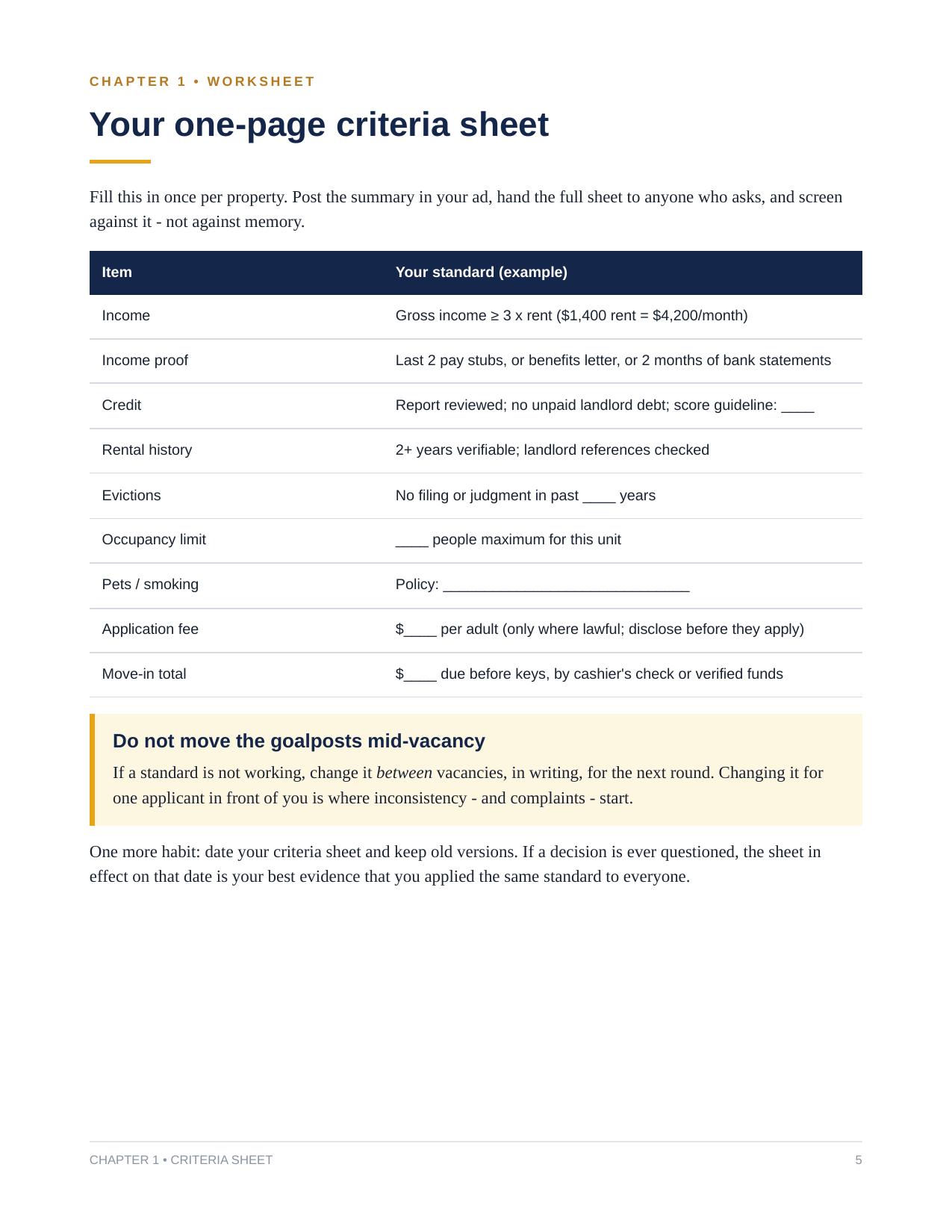
Fill this in once per property. Post the summary in your ad, hand the full sheet to anyone who asks, and screen against it - not against memory.
If a standard is not working, change it between vacancies, in writing, for the next round. Changing it for one applicant in front of you is where inconsistency - and complaints - start.
One more habit: date your criteria sheet and keep old versions. If a decision is ever questioned, the sheet in effect on that date is your best evidence that you applied the same standard to everyone.
Fair housing is not a trap for careful landlords. It is a simple discipline: judge the application, never the person.
Same form, same fee, same checks, same questions — for every applicant. Your state and local list may be longer than the federal list; learn yours before you advertise.
Federal law protects applicants based on race, color, religion, sex, handicap (disability), familial status, and national origin. Many states and cities add more - for example source of income, sexual orientation, gender identity, age, or marital status. Your state list may be longer than the federal list. Learn yours before you advertise.
This chapter is a plain-language overview, not a legal summary of your jurisdiction. Check your state and local fair-housing rules - they are often stricter than federal law.
Most fair-housing trouble starts as casual language - in an ad, a text, or a showing. Use property language and criteria language, and you will stay out of most trouble before it starts.
Do not ask about race, religion, national origin, family plans, disability, or where someone was born - in the ad, on the phone, on the form, or at the showing. If an applicant volunteers personal information, be polite, do not write it in your screening notes, and return to the application: income, history, references, timeline.
Write notes as if the applicant will read them one day - because in a dispute, they might. "Income verified at $4,450/month; prior landlord confirmed on-time payments" ages well. Personal comments do not.
A clear ad is your first screen. It should repel the wrong fit before they call and reassure the right fit that you run a real operation.
A clear ad is your first screen — it should repel the wrong fit before they call. Take the ad down the day the lease is signed.
"Bright 2-bedroom, 1-bath apartment, second floor. $1,400/month plus utilities. Available June 1, 12-month lease. No smoking. One small dog considered with deposit where lawful.
Screening: every adult (18+) completes an application. Gross income at least 3 times the rent, verifiable rental history, and a credit and background check for every applicant. Application fee $40 per adult. First complete, qualified application is processed first."
Post where renters actually look in your market, answer inquiries with the same short pre-screening reply (Chapter 13), and take the ad down the day the lease is signed. A stale ad creates calls you cannot serve and applicants you have to disappoint.
No application, no consideration. No exceptions for friends, referrals, coworkers, or the applicant who "can pay cash today."
No application, no consideration — no exceptions. Process applications complete-first, not contacted-first: form filled, ID provided, fee paid, consent signed.
Every adult who will live in the unit applies, consents in writing to credit and background checks, and is screened the same way. That includes adult children, partners, and roommates - anyone on the lease, and anyone living there, should be on paper.
Time-stamp every application when it becomes complete - form filled, ID provided, fee paid if you charge one, consent signed. Process in that order. "I turned mine in first" disputes disappear when the rule is complete-first, not contacted-first.
Keep applications, reports, and notes together in one file per vacancy, and keep denied-applicant records for the period your state requires. Organized files are quiet proof that your process is real.